The Buddha
Aaron Garrity
T H E M A S T E R S O F B E I N G
THE BUDDHA
THE END OF NEEDLESS SUFFERING
The Buddha, the Architecture of Attachment, and the Freedom of Seeing Clearly
A A R O N G A R R I T Y
T H E M A S T E R S O F B E I N G
THE BUDDHA
THE END OF NEEDLESS SUFFERING
Copyright © 2026 Aaron Garrity
All rights reserved.
This work may be downloaded and shared freely in its complete, unaltered form for noncommercial purposes with attribution. No commercial use, adaptation, or republication, in whole or in part, without prior written permission.
Cover and closing artwork: original visual interpretations created for this edition.
First digital edition, 2026
A A R O N G A R R I T Y . C O M
PROLOGUE
THE PALACE WE BUILD AGAINST LOSS
As we make our way through life, loss introduces itself in forms we do not yet know how to name. For a child, it may be a favorite toy that cannot be found, a grandparent whose chair is suddenly empty, or a friend who moves away. As the years pass, the stakes deepen. A relationship changes. A parent dies. A child leaves home. A business ends. The stability we trusted reveals that it was never a promise. Loss changes its clothing, but the question remains: What do we do when life no longer resembles the future we had already begun to inhabit?
When I was a boy, my grandmother lived with Parkinson's disease and was often in and out of the hospital. More than once I heard that she might be near death, and more than once she returned home. Then, while I was away at a summer music program, my mother called with the same warning. This time, something in me knew I needed to go.
I walked into a cold hospital room. My mother and my aunt were already there. My grandmother lay with her eyes closed, tubes down her throat and machines helping her breathe. There were no words available to her. There was only the sound of the equipment, the stillness of the room, and the sight of a woman I loved suspended between presence and departure. I began to cry.
My aunt, who was a music teacher, said quietly, "Why don't you sing for her?" Music belonged to our family. My grandfather had been a professor of music. My grandmother had taught it, and when she cared for me as a small child, we sang together in the car on the way home.
So I sang the pieces I had been studying, and then the songs my grandmother and I had once sung together. In the middle of one of them, she began to hum. Then she tried to sing. Her body was failing, but for a moment the music found the part of her that illness had not silenced. The gift had begun with her, passed into me, and now returned when speech was no longer possible.
That night she passed.
The grief was real. But it was not the whole truth of that room. The ending did not erase the life that came before it. It gathered that life into a final exchange: what she had given me came home to her. I may have learned there, long before I had language for it, that sorrow and gratitude can occupy the same human heart.
My education in loss has moved through more than one world. I grew up with very little and did not understand that we were poor. Later, I experienced extraordinary abundance and the responsibilities that accompanied it. This is not a story of having everything and then losing everything. That would not be true. It is the story of discovering that neither scarcity nor opulence exempts a human being from change.
I have lost people, relationships, expectations, business ventures, and forms of life into which I had poured years of conviction. I have also watched new life emerge after endings that once appeared final. For much of my life, I believed suffering came primarily from what life took from me. I understood disappointment, betrayal, and the collapse of things once believed permanent. What I understood less clearly was how much suffering came afterward.
Pain came through what life altered. Needless suffering came through the mind's refusal to release what reality had already changed. There is the loss itself. Then there is the argument we continue having with it. The Buddha built his teaching inside the distance between those two things.
Before he became the Buddha, Siddhartha Gautama was a protected son. According to tradition, his father feared a prophecy that the prince might abandon the throne for a spiritual life, so illness, aging, and death were kept outside the palace walls. Youth surrounded him. Beauty entertained him. Every visible condition suggested that sorrow could be managed by keeping it out of sight.
The palace was more than a residence. It was an argument: if life were arranged carefully enough, perhaps nothing unbearable would enter. Human beings have been rebuilding that palace ever since. We build it through wealth, romance, reputation, achievement, family, certainty, and the future we quietly assume will arrive. We build it whenever we ask something temporary to make us permanently safe.
For a time, the palace works. That is what makes it convincing. Success can change the conditions of a life. Money can provide freedom, care, and opportunity. Love can give existence a depth it would not otherwise possess. There is nothing enlightened about pretending these things do not matter.
But none of them can promise permanence. A trusted person betrays us. A relationship changes. A parent dies. A child suffers. The body begins revealing the passage of time. A future we had already inhabited in imagination refuses to become the life that arrives.
One business I helped build for nearly twenty years ended abruptly in a sale. I had to decide which truth would become the whole story: the ending, or the years of growth, expansion, and changed lives that preceded it. Both were true. The ending deserved grief. It did not deserve exclusive ownership of the meaning.
What I discovered beneath that ending was something innate in all of us: the ability to create again. What once moved through us has not necessarily vanished because one form has closed. Capacity survives form. Imagination survives disappointment. Life may dismantle what we built without removing the builder within us.
Fatherhood makes that truth more tender, not less. A new father holds a child and almost immediately begins furnishing the future: school doors, protection, accomplishment, heartbreak, the person this small life may become. Love begins in the present, but the mind reaches ahead. Years later, when the child leaves home, sadness is only one side of the moment. The whole truth includes the years of nurturing, the conversations, the lessons, the hugs that came freely, and the ones distance made impossible.
If we look only at the leaving, we abandon the life that made the leaving meaningful. To love a child is to encounter beauty and impermanence at the same time. Nonattachment does not require loving less. The Buddha did not awaken because he stopped loving life. He awakened because he stopped demanding that life remain unchanged in order to be loved.
That distinction lies at the center of this writing. Attachment is not devotion. It begins when love becomes possession, purpose becomes identity, or an outcome becomes the condition upon which we grant ourselves peace. We can become attached not only to people, but to explanations, apologies, positions, and former versions of ourselves. Some wrongs require justice. Some relationships require repair or distance. Acceptance does not declare harm acceptable. It means seeing what has happened clearly enough to decide what life asks of us now.
Siddhartha's protected world was broken open by four encounters: an old man, a sick person, a corpse, and a spiritual seeker. Whether the events unfolded precisely as tradition remembers them matters less than the recognition they contain. The prince who had been surrounded by curated youth suddenly saw a body bent by age. He saw illness make a stranger of the body. He saw a corpse and understood that rank could not negotiate with death.
Each sight removed one wall from the palace within him.
Then he saw a wandering seeker. The man possessed almost nothing, yet carried a composure the palace had been unable to manufacture. The first three encounters revealed the conditions of human life. The fourth revealed a possibility: perhaps age, illness, separation, and death could be met without allowing them to destroy the consciousness that met them.
This was not pessimism. It was contact with reality. Most of us experience our own four encounters. Life eventually introduces us to what our private palace was designed to conceal. Our first response is often to repair the palace. We find another relationship, another ambition, another structure of certainty. We tell ourselves the problem was not attachment, only that we attached ourselves to the wrong person, company, dream, or outcome.
Sometimes that is true. Discernment matters. But beneath the correction, a deeper demand may remain: This time, I will build a life that cannot be taken from me.
There is no such life. This does not mean we should stop building. Build the company. Love the person. Raise the children. Defend what matters. Create something worthy of remaining after you are gone. But do not bury your freedom inside what cannot remain.
Pain will still come. Grief may be the honest price of having loved. Trauma cannot be dismissed with a spiritual phrase, and the teaching becomes cruel if it blames people for every suffering they endure. But pain is not the whole story. There is what happens to us, and there is what the mind continues doing with what happened. It repeats the injury, rehearses the argument, constructs an identity around the wound, and waits for a past that cannot return.
Pain enters. The mind builds it a home. The Buddha's path begins with the possibility that this second structure can be seen. What can be seen clearly no longer has to govern us unconsciously. That is awakening in its most human form: not escape from ambition, love, fatherhood, leadership, or desire, but freedom from requiring any of them to tell us who we are.
The question is not whether we can avoid losing what we love. We cannot. The deeper question is whether love can mature beyond possession, whether ambition can survive without captivity, and whether a human being can meet change without allowing every change to become a collapse of the self.
Siddhartha left the palace carrying that question. His life became an answer. But reaching it would require him to lose every false version of freedom first.
I THE FAILURE OF EXTREMES
Leaving the palace did not make Siddhartha wise.
It made him exposed. For the first time, there were no walls between him and the conditions of being human. No music to conceal sorrow. No servants to remove what had begun to decay. No carefully arranged beauty protecting him from the knowledge that everything beautiful must change. He had left behind wealth, rank, and the future prepared for him. But he had also left behind Yasodhara. He had left behind his infant son.
This is where the story becomes more difficult than legend sometimes allows. It is easy to admire the man walking into the forest. It is harder to remain with the woman who awoke without him. Harder still to imagine the child who would one day learn that his father had gone searching for an answer large enough to justify his absence. Awakening does not begin in moral perfection. It begins in human contradiction.
Siddhartha did not leave because he felt nothing. He left because he could no longer pretend that love, privilege, and fatherhood could protect anyone from sickness, aging, separation, and death. He looked upon those he loved and understood something unbearable. He could not keep them. Not because he did not love them enough... but because no amount of love could prevent life from changing them.
The palace had promised permanence. His wife and son revealed how desperately he wanted that promise to be true. So he went into the wilderness carrying more than a question. He carried guilt. He carried longing. He carried the memory of those he had left sleeping. And perhaps this is why his search became so severe. A man who has abandoned one life in pursuit of truth cannot easily admit that he may have been wrong.
The greater the sacrifice, the more desperately we need the sacrifice to mean something.
Siddhartha found teachers who had mastered extraordinary states of consciousness. He learned to quiet thought. He entered dimensions of stillness most human beings would never know existed. The early texts remember two of them by name: Alara Kalama and Uddaka Ramaputta. Siddhartha learned quickly enough that each teacher invited him not merely to study, but to remain and share authority. He could have exchanged one palace for another. This palace would have been built from spiritual attainment, reverence, and the approval of accomplished men.
But Siddhartha was not searching for a state others would admire.
He was searching for a freedom that would remain when the state had passed. Yet each time he returned, the same fact remained. The state passed. The mind returned. The old hunger waited for him. He could leave ordinary consciousness... but he had not yet become free within it. So he went further. If pleasure had failed him, perhaps pain would purify him. If the body carried desire, perhaps the body had to be conquered.
He fasted until his limbs resembled branches. He held his breath until consciousness trembled. He exposed himself to heat, cold, exhaustion, and hunger. The prince who had once been protected
from discomfort now became merciless toward himself. But the palace and the forest were not yet opposites.
They were reflections. In the palace, he had been governed by the pursuit of pleasure. In the forest, he was governed by the pursuit of pain.
One worshipped the body. The other punished it. Both made the body the center of the search. Both were forms of captivity. There is a violence hidden inside many attempts at . We find something within ourselves that frightens us... desire, anger, ambition, grief, weakness... and immediately declare war. We call it discipline. We call it purification. We call it strength. But beneath the language is often the same ancient refusal:
I cannot be at peace until this part of me is gone.
Siddhartha had escaped the palace... but he had not yet escaped resistance. He was still trying to force reality into submission. Only now, the reality he was trying to defeat was himself. His companions revered him for it. They watched him become thinner, quieter, more severe. To them, his suffering appeared holy. This is one of the most dangerous things about extremes.
They are often mistaken for devotion.
Intensity can look like truth. Exhaustion can look like commitment. can look like sacrifice. And when others admire us for what is harming us, it becomes even harder to stop. I know something of this temptation. There have been seasons when I believed the answer was always more. More effort. More hours. More pressure. More willingness to carry what others could not. In business, this can be praised as leadership. In fatherhood, it can disguise itself as provision. In life, it can feel like strength.
But there is a point at which perseverance ceases to serve the purpose and begins to serve the identity. We no longer endure because something meaningful requires it. We endure because we have become attached to being the one who can. And then rest feels like weakness. Help feels like failure. A different direction feels like betrayal. The very quality that carried us forward becomes the thing that will not allow us to change.
Siddhartha reached that edge. Near death, another memory returned. As a child, seated beneath the shade of a rose apple tree while his father attended a ceremonial plowing, Siddhartha had entered a natural stillness. It had not been forced by hunger or purchased by pleasure. It had arisen through unguarded attention. The memory confronted the logic of his extremism. Perhaps not every form of ease was indulgence. Perhaps a mind could become quiet without the body becoming an enemy.
He asked himself a question that broke the authority of the ascetic identity:
Why am I afraid of a that does not depend upon craving? His body was failing. Tradition tells us that he touched his stomach and felt his spine. Whatever truth he was seeking, he was now too weak to receive it. He had brought himself close to death... and death had revealed nothing.
This may have been one of the most honest moments of his life. Not when he left the palace. Not when others called him holy. But when he admitted that the path into which he had poured everything was not leading him home. There is courage in enduring. self improvement
Self destruction
wellbeing
There is another kind of courage in releasing the identity built around endurance. Near the river, a young woman named Sujata saw him. She offered him milk rice. A simple bowl of nourishment.
Yet to receive it, Siddhartha had to surrender an entire image of himself. The ascetic. The exceptional one. The man who needed nothing. The seeker whose suffering proved the seriousness of his search. He lifted the bowl. He ate. And in that quiet act, an old self began to die. His companions were appalled. They believed he had abandoned the path. But he had abandoned only the extreme.
There are moments when healing looks like failure to those who have mistaken your suffering for your virtue. There are moments when the most awakened thing you can do is accept what your identity has taught you to refuse. Food. Rest. Tenderness. Help. A new understanding. The permission to begin again. The bowl did not give Siddhartha enlightenment. It gave him back the instrument through which enlightenment could be realized.
He began to understand that freedom would not be found through indulgence or punishment. Neither gratification nor denial could end desire. Both remained organized around it. The answer was not to obey every hunger. Nor was it to fear hunger itself. The answer was to see it clearly. This was the beginning of the Middle Way. Not a timid compromise between pleasure and pain. Not a philosophy of moderation for those afraid to commit.
The Middle Way was far more exacting than either extreme. It demanded that he remain present without escaping into pleasure... and remain compassionate without turning pain into a religion. It asked him to abandon both forms of intoxication. The intoxication of having. And the intoxication of renouncing. The Middle Way is not found halfway between two illusions.
It begins when we see what both illusions have in common.
Attachment. The mind fastening itself to a method, an identity, an outcome, and saying: This must save me. How often do we do the same? We pursue success as though achievement will end uncertainty. Then, exhausted by striving, we romanticize walking away. We cling to the relationship. Then call withdrawal freedom. We worship ambition. Then condemn desire. We build an identity around control. Then build another around surrender.
But attachment does not disappear merely because its object changes. The executive can be attached to expansion. The monk can be attached to renunciation. The wounded can become attached to the wound. The healer can become attached to being needed. The father can become attached to being strong. Even the seeker can become attached to awakening. The architecture remains the same.
Something outside or ahead of us becomes the condition upon which we grant ourselves peace.
Siddhartha had lived inside both sides of the structure. He had known abundance without freedom. He had known deprivation without freedom. Now he began to see that suffering was not located in what he possessed or what he denied himself. It was located in the grasping. In the demand. In the belief that life must take a particular form before he could meet it without resistance.
This did not make him passive. It made him available. Available to truth beyond preference. Available to experience without immediately turning it into identity. Available to love without demanding permanence as the price of loving. The Middle Way would not remove pain from his
life. It would remove the needless war against pain. It would not make him indifferent to loss. It would free him from the belief that loss invalidates love.
It would not ask him to become detached from life. It would free him from being internally governed by every change within it. That distinction would become the center of everything. Siddhartha had spent years trying to overcome the world. Then he had spent years trying to overcome himself. Both attempts had failed. Because freedom was never going to come through conquest. It would come through seeing.
He bathed in the river. He accepted nourishment. His strength slowly returned. Then he walked toward a fig tree and prepared a seat beneath its branches. He was no longer the prince who believed comfort could protect him. He was no longer the ascetic who believed pain could purify him. He had followed both promises to their end. Now there was nowhere left to run.
He sat beneath the tree with his body restored, his illusions wounded, and his life reduced to a single uncompromising question: What remains when nothing is resisted... and nothing is grasped? Until then, he had tried to change the conditions of consciousness. Beneath the tree, he would turn toward the consciousness experiencing them.
II THE ARCHITECTURE OF ATTACHMENT
Beneath the tree, Siddhartha began to see what the palace and the forest had both concealed. The world was not the only source of his suffering. The mind was participating. The old stories place Mara beside him that night. Mara is often treated as a demon who arrived from somewhere outside the human mind. But the story becomes more penetrating when we recognize what Mara brought: fear, desire, accusation, and the final temptation to abandon the seat before truth had fully revealed itself.
Mara did not need Siddhartha to return to the palace. He needed only to make him identify with what was passing through him. You are afraid. You desire. You are unworthy. You have no witness. These are not ancient voices. They are the architecture of attachment speaking in the first person. Siddhartha did not defeat Mara by arguing with every thought. He did not try to destroy desire through force or prove his worth to the accusing mind. Tradition remembers him lowering one hand and touching the earth.
The gesture is among the most powerful in the history of spiritual art.
The earth did not flatter him. It did not promise success. It simply bore witness to what was real.
This body is here. This breath is here. Fear is arising. Desire is arising. None of it must be obeyed merely because it has appeared.
Mara’s authority ended when Siddhartha stopped confusing the voice within consciousness for consciousness itself.
Experience would arise... and almost immediately, the mind would reach toward it or pull away. Pleasure appeared. The mind said, More. Pain appeared. The mind said, Not this. Something beautiful arrived. The mind said, Stay. Something beloved began to change. The mind said, You cannot. This movement was so immediate that it seemed inseparable from life itself. But Siddhartha watched closely enough to see the space between what happened...
and what the mind demanded should happen instead. Inside that space, suffering was being built. Not all suffering. The body would still know illness. Age would still alter the face. Those we love would still leave, change, or die. There would be pain no philosophy could honestly deny. But around that pain, the mind constructed something more. Resistance. Prediction. Identity. The memory of what had been.
The demand that it return. The fear that what remained would not be enough. This was suffering added to suffering. And it began with attachment. Attachment is often misunderstood because we confuse it with caring. We imagine that releasing attachment means becoming indifferent. That if we no longer cling, we will no longer love. That if we stop needing an outcome, we will stop working toward it.
That if we accept impermanence, nothing will matter. But attachment is not devotion. Devotion gives itself to what is present. Attachment demands that what is present remain. Love says: I am
here. Attachment says: You must stay as I need you to be. Ambition says: Let us build something meaningful. Attachment says: If this fails, I become less. Responsibility says: This is mine to carry.
Attachment says: Without me, everything will collapse. The difference is rarely visible from the outside. The same person may work long hours from love or from fear. A parent may protect a child from wisdom or from the inability to tolerate the child’s pain. A leader may defend a company because it serves people... or because its success has become the evidence upon which his worth depends.
The action may look identical. The inner architecture is not.
Attachment begins when preference becomes a condition for peace.
Preference is human. We prefer health to illness, connection to loneliness, and success to failure. Suffering begins when preference hardens into a private command: this must happen; that must never happen. Life has signed no such contract.
If I am good, life will be fair. These are not foolish hopes. They are profoundly human attempts to negotiate with uncertainty. But life does not accept our terms. The business can fail after years of sacrifice. The loyal can be betrayed. The careful can become ill. The strong can become tired. The child can choose a life the father would not have chosen. The future can arrive wearing none of the forms we prepared for.
I have known what it is to build something with years of thought, sacrifice, loyalty, and conviction... and then watch circumstances change faster than identity could follow. The loss was real. But beneath the loss was another fear. If what I built can disappear... what does that make me? This is where attachment reveals its deepest structure. We do not cling only to people, possessions, or outcomes.
We often cling less to the thing than to what it allows us to believe about ourselves. A title becomes evidence of importance. A relationship becomes evidence of lovability. A victory becomes evidence that the struggle mattered. Then losing the thing feels like losing the self built beside it.
This is why certain losses feel larger than what was lost. A company declines... and a man does not merely lose revenue. He loses the future in which his sacrifices made sense. A relationship ends... and a woman does not merely lose a partner. She loses the version of herself who believed she had finally been chosen. A child grows... and a father does not merely watch time pass.
He confronts the fact that love cannot stop the beloved from becoming someone beyond his protection. A face ages... and the mirror does not merely reveal lines. It threatens an identity built around youth, beauty, strength, or possibility. The event touches the structure. The structure begins to shake. And because we mistake the structure for the self... we believe we are the ones disappearing. The Buddha’s insight was not that nothing exists.
It was that nothing we experience remains fixed. The body changes. Emotion changes. Thought changes. Status changes. Relationships change. Even the personality we defend as me is moving. We are not the same person at fifty that we were at twenty. We do not love with the same innocence after betrayal. We do not lead with the same certainty after failure. We do not hold our children the same way once we understand that we cannot walk their path for them.
Life does not ask whether we consent to this movement. It moves. Impermanence is not a defect in existence. It is the nature of existence. The flower is beautiful because it blooms. Its fading does
not invalidate the bloom. The child’s growing does not betray the years when he needed your hand. The ending of a season does not prove the season was meaningless. But attachment cannot see this.
Attachment interprets change as theft. It believes that if something mattered, it should remain. If love was real, it should have lasted in the same form. If the work was worthy, it should have succeeded. If loyalty was given, loyalty should have been returned. If we were once strong, we should never become weak. Attachment does not merely want life. It wants immunity from life’s movement.
The story is repeated until the event is no longer simply something that occurred. It becomes who we are. The one who was betrayed. The one who failed. The one who was abandoned. The one who was not recognized. The one whose best years are behind him. Pain becomes biography. Biography becomes identity. Identity begins protecting the wound that created it. This is why healing can feel threatening.
If the wound disappears... who are we without the story we built around it? Some people remain attached to what harmed them because their entire understanding of themselves formed in response to it. The wound gives them innocence. It gives them explanation. It gives them someone to blame. It gives shape to a life that might otherwise demand a frightening new question: What will I become now?
Releasing the wound does not mean pretending it never happened. Forgiveness does not rewrite history. Acceptance does not declare injustice acceptable. Seeing clearly does not require us to remain where we are being harmed. The Buddha did not teach submission to cruelty. He taught freedom from allowing cruelty to continue governing the mind after the moment had passed. There is a difference between remembering what happened...
and allowing what happened to become the author of everything that follows. I have known betrayal. Most people who have trusted deeply have. The pain is not imaginary. Something sacred is damaged when the person we trusted proves unable or unwilling to protect what was entrusted to them. But betrayal contains a second danger. We can become so attached to the justice of our pain that we give the betrayer a permanent place within us.
We leave the relationship... but carry the courtroom. We replay the evidence. We restate the charges. We imagine the confession that would finally release us. And without realizing it, our peace remains dependent upon the transformation of the person who wounded us. This is attachment wearing the face of justice. It says: I cannot be free until you understand what you did. But what if they never understand?
What if the apology never arrives? What if they tell the story differently? What if life refuses to produce the ending our pain believes it deserves? Must freedom wait? The Buddha’s answer was no. Not because the wound did not matter. Because it mattered too much to surrender the remainder of a life to it. Attachment is not defeated by force. The attempt to destroy attachment becomes another attachment.
We begin performing nonattachment. We deny what we want. We conceal what we feel. We withdraw before anyone can leave us. We call numbness peace. We call avoidance wisdom. We call emotional distance freedom. But a heart that cannot be broken may simply be a heart that cannot
be reached. This is not awakening. It is fear made spiritual. The freedom Siddhartha discovered was more demanding.
The freedom Siddhartha discovered was not withdrawal. It was the capacity to love without ownership, build without demanding permanence, lead without controlling every consequence, and grieve without abandoning the life that remains.
because we are already trying to preserve it. Nonattachment returns us to what attachment continually postpones. Presence. To be present is not to believe the moment will last. It is to stop requiring it to last before we allow ourselves to receive it. I cannot keep my children eight years old. I cannot protect them from every grief waiting somewhere beyond my sight. I cannot ensure that they will always understand my choices, share my beliefs, or remember me exactly as I hope to be remembered.
Fatherhood offers no such contract. What it offers is more immediate... and more sacred. This conversation. This walk. This hand in mine. This chance to be fully here before time carries all of us forward. The attempt to keep them would make their lives smaller. The willingness to release them is not the end of fatherhood. It may be its most mature expression. Love does not become less real when it stops trying to possess the future.
Protect what has been entrusted to you. But do not make the outcome responsible for telling you who you are.
Otherwise fear enters every decision. You begin protecting your identity instead of serving the purpose. You silence necessary truth because the truth threatens the structure. You keep the wrong person because admitting the mistake feels like weakness. You force what should be released. You preserve what has already stopped living. You call it commitment. But what you are protecting may no longer be the work.
It may be yourself. Nonattachment does not weaken responsibility. It purifies it. When identity is no longer demanding protection, we can see what the moment actually requires. We can change direction without interpreting change as defeat. We can hear criticism without collapsing into shame. We can succeed without believing success has made us superior. We can fail without turning failure into a permanent definition. We can make the difficult decision without needing everyone to approve of the one who made it.
This is awakening inside the world. Not the absence of preference. Not the death of desire. Not withdrawal from love, family, leadership, or creation. It is freedom from the hidden demand that these things complete what we have refused to recognize within ourselves. The Buddha did not ask us to stop touching life. He asked us to notice when the hand becomes a fist. The fist cannot receive.
It can only hold. And eventually, everything held by force begins to suffer beneath the holding. The beloved feels controlled. The child feels burdened. The organization feels the fear of its leader. The body feels the war against age. The mind feels the exhaustion of defending a self that life is continually changing. Release begins not when we throw everything away... but when we open the hand.
The person may remain. The work may continue. The dream may still be pursued. Only the demand changes. I may give myself fully without requiring permanence. I may fail without becoming a failure. This is not detachment from life. It is full participation without captivity.
It is intimacy without captivity. After awakening, the Buddha returned first to the five ascetics who had abandoned him when he accepted nourishment. They expected a failure walking toward them. Instead, they encountered a man no longer defending either indulgence or deprivation. At the Deer Park, he gave language to what his life had discovered: “Avoiding these two extremes, the Realized One understood the middle way.” It gives vision, he continued, and leads to peace.
The teaching carried the authority of embodiment.
He had lived the extremes before he named the way between them.
He had known attachment as a prince, as an ascetic, and as a seeker attached even to the identity of seeking. The Four Noble Truths were not an argument he had won. They were the map of a captivity he had survived. But even after attachment is seen, pain still comes. The body is struck. The trust is broken. The diagnosis is spoken. The child suffers.
The future closes. That first wound belongs to being alive. What happens next... belongs to the mind. And it was there that the Buddha discovered the second arrow.
III THE SECOND ARROW
In the Sallatha Sutta, the Buddha described suffering through the image of a man struck by an arrow.
“It is as if a person were struck by an arrow,” he said, “only to be struck by a second arrow.” The first arrow enters the body. It hurts. Before the man can recover, a second arrow follows. Then another. The first arrow is the pain life delivers. The second is everything the mind adds. The event. Then the interpretation. The wound. Then the story of the wound.
The loss. Then the fear that life will never again contain what was lost. The first arrow says:
This hurts.
The second says:
This should not be happening.
I cannot survive this.
I will never be whole again.
This proves I was never enough.
This always happens to me.
Nothing will ever be safe.
Pain occupies the moment. Suffering recruits the past and the future. It gathers every similar wound we have known and every consequence we can imagine. It turns one moment into a lifetime. The first arrow may be unavoidable. The second arrow is where needless suffering can begin. But this teaching must be handled with enormous care. It must never become a spiritual accusation against people in pain.
A grieving mother is not failing because she cannot release her grief. A person living with trauma is not choosing each reaction in the ordinary sense of choice. The body remembers what the conscious mind may no longer be able to name. Fear can enter before thought. The heart can race before reason has spoken. A sound, a face, a room, or a silence can reopen what years have covered.
There are wounds that reshape the nervous system. There are losses that alter the architecture of a life. There are depressions that cannot be overcome through a beautiful sentence. There are injustices that require action, protection, and repair. The second arrow is not always consciously chosen. Often, it is conditioned long before we can name it. The teaching is not a doctrine of blame. It is an invitation to notice where freedom may still be possible.
The later Buddhist tradition preserved this same compassion in the story of Kisa Gotami. Her child had died, but grief would not allow the fact to enter. She carried the small body from house to house, asking for medicine, until someone directed her to the Buddha. He did not lecture her about impermanence. He did not tell her that attachment had made her grief unenlightened.
He asked her to bring him a mustard seed from a home untouched by death.
The request gave grief somewhere to walk.
At one door, a father had died. At another, a daughter. Another household had buried a husband, a mother, or a child. The mustard seed was common. A home without loss could not be found. By evening, the Buddha had not removed her pain. He had changed the world in which she believed she alone was carrying it.
Her sorrow was personal. Death was universal.
That distinction did not diminish her child. It released grief from the isolation that had made reality impossible to enter. This is how the Buddha often taught. He did not force an idea into a wounded mind. He created an encounter through which truth could be discovered without violence.
Freedom does not begin when reaction disappears. It begins when awareness enters the reaction. The second arrow is rarely fired once. It returns through repetition.
We wake in the night and replay the conversation. We hear the tone again. We reconstruct the moment until the body no longer knows that the event has ended. The jaw tightens. The chest contracts. Sleep becomes impossible. Nothing is happening now, yet everything is happening again. I have known those nights. The world outside is still while the mind holds meetings no one else is attending.
Modern life can keep those meetings permanently in session if we allow it. Social media, email, texts, and calls make us reachable almost everywhere. Matters arrive from different parts of the world carrying the urgency of the person sending them. There was a point when I told the general counsel who headed my legal team not to call me after eight o'clock at night. He was informing me because that was his responsibility. I had to establish the boundary because protecting the condition of my mind was mine.
The problems did not become less real after eight. But the body needed to learn that vigilance was not the same as leadership. A mind denied rest does not become more responsible. It becomes more vulnerable to the very fear it believes it is managing.
Early in one of my first business ventures, I learned how deliberately that fear can be used. A larger company came after us. We were served with legal papers as we came out of church, our children beside us, an act calculated to make the threat enter the family, not merely the courtroom. We were told that one of its founders had said not to stop until we and our families were on the street.
The threat required lawyers, facts, preparation, and resolve. But the mind could still turn another person's intention into a future already completed. The first arrow was the attack. The second was allowing their desired ending to become the only future I could see.
Courage meant preparing fully without surrendering the interior life of my family to someone else's threat. We believe that if we think about the problem long enough, we will gain control over it. But thought cannot always solve what thought is repeatedly recreating. There is reflection that
clarifies. And there is rumination that keeps the wound open while the mind searches for an ending that no longer exists. Wisdom learns the difference. The second arrow often enters through meaning. The event itself may be painful.
But the meaning assigned to it determines how deeply it becomes entangled with identity. A business fails. That is the event.
I am a failure.
That is the second arrow. Someone leaves. That is the event.
I am unlovable.
That is the second arrow. The body becomes ill. That is the event.
My body has betrayed me.
That is the second arrow. A child struggles. That is the event.
I have failed as a father.
That is the second arrow. The interpretation may feel inseparable from what happened. But it is not the same thing. Events carry consequence. The mind assigns identity. This distinction does not remove responsibility. If I made a poor decision, seeing clearly requires me to acknowledge it. If I harmed someone, freedom does not come through pretending I did not. If trust was broken, the damage must be faced.
Acceptance is not the refusal of accountability. It is the refusal to turn accountability into . There is a difference between saying:
I failed.
And saying:
I am failure.
One describes an event. The other creates a prison. The second arrow often disguises itself as honesty. We believe we are being realistic when we speak to ourselves with cruelty. We call shame accountability. We call hopelessness maturity. We call remorse. But punishment is not transformation. A person can hate himself for the same mistake for thirty years and never become wise enough to stop repeating it.
Shame keeps the self at the center. It says:
Look at what this proves about me.
Responsibility turns toward consequence. It asks: What must become different because this happened? One protects an identity through condemnation. The other permits change. This matters profoundly in leadership. When the leader cannot tolerate the pain of being wrong, the entire organization becomes responsible for protecting him from the first arrow. Information is softened. Failure is hidden. Dissent becomes betrayal. The truth is delayed until the consequences are too large to conceal.
The original mistake may have been survivable. The refusal to experience the pain of admitting it creates the second arrow for everyone. A leader who can say, I was wrong, prevents suffering from self annihilation
self punishment
multiplying. A leader who cannot will ask an entire culture to bleed in defense of his The second arrow is not merely personal. It can become institutional. Families do this. Companies do this.
Religions do this. Nations do this. An old wound becomes a story. The story becomes an identity. The identity requires an enemy. The enemy justifies the continuation of the wound. Soon, no one remembers the original arrow. They know only that pain has become sacred... and that releasing it would feel like betrayal. This is how suffering passes between generations. The child inherits a fear whose origin he never witnessed.
The employee inherits a culture built around a founder’s insecurity. The believer inherits guilt from a question no one is permitted to ask. Unexamined pain seeks continuation. Sometimes it wants witnesses. Sometimes it wants agreement. Sometimes it wants someone else to hurt enough to prove that the first wound mattered. This is why revenge promises relief but rarely brings freedom. It transfers the arrow. It does not remove it.
The person who wounded us may deserve consequence. Justice may be necessary. Boundaries may be essential. But if our peace requires their suffering, we remain bound to them. The form of the bond has changed. The captivity has not. The second arrow can also be fired forward. Nothing has happened yet... but the mind suffers in advance. The medical test has not returned. The child has not called.
The contract has not been lost. The relationship has not ended. But imagination has already constructed the funeral. Anxiety is often pain borrowed from a future that has not arrived. Its purpose is protection. Its effect can become imprisonment. It tells us that constant vigilance will prevent surprise. Yet a life devoted to preventing future pain becomes a life continually experiencing pain before it exists.
We lose people who are still beside us. We fail in rooms we have not entered. We grieve futures that have not been taken. The mind believes it is preparing the body. Often, it is simply exhausting it. The answer is not to become careless. Preparation matters. Discernment matters. The future deserves responsible attention. But there is a difference between preparing for possibility... and inhabiting catastrophe.
Wisdom prepares. Fear rehearses. Wisdom responds to evidence. Fear treats imagination as evidence. Wisdom takes the next necessary step. Fear attempts to live every possible future at once. No human nervous system was designed to carry that many lives. The practice begins by returning to the arrow that is actually here. Not yesterday’s arrow. Not tomorrow’s. This one. What is happening now? What does the body feel?
What fact is present before interpretation begins? What requires action? What is being added? These questions do not make pain disappear. They stop the mind from multiplying it without being noticed. Perhaps the fact is:
Someone I trusted lied to me.
The addition may be:
No one can ever be trusted.
Perhaps the fact is: identity.
My body is aging.
The addition may be:
My meaningful life is ending.
Perhaps the fact is:
My child is hurting.
The addition may be:
I must control every circumstance until the hurt is gone.
The fact deserves our presence. The addition requires our awareness. Seeing the difference creates room. And within that room, we begin to recover choice. Not control over what happened. Not certainty about what comes next. Choice in how deeply the event will be permitted to define the consciousness meeting it. This is why awareness matters. Awareness does not argue with the mind. It sees the mind.
It notices the prediction without becoming the prediction. It feels the grief without converting grief into identity. It hears the accusation without assuming every accusation is truth. It allows the body to tremble without declaring the trembling weakness. The mind says:
This will destroy me.
Awareness responds:
Fear is here.
The mind says:
I will never recover.
Awareness responds:
Hopelessness is here.
The mind says:
I should not feel this.
Awareness responds:
Pain is here.
That small change in language is not avoidance. It is the restoration of proportion. I am afraid can make fear feel like the whole self. Fear is here allows fear to be real without becoming everything. The storm is present. But the sky has not become the storm. This is not a trick of vocabulary. It is a shift in identity. Siddhartha saw that thought could be witnessed.
Emotion could be felt without becoming the whole of the one who felt it. Sensation could rise, change, and pass. No single experience contained the whole of him. Awareness did not need to destroy these experiences. It became the space in which they could complete their movement. Much of suffering persists because we interrupt that movement. We resist grief. So grief cannot move. We judge fear.
So fear acquires shame. We suppress anger. So anger enters the body and waits. We refuse helplessness. So helplessness disguises itself as control. The emotion arrives as an honest response. The mind condemns the response. Now there are two pains. The wound... and the belief that we should not be wounded. Sometimes the second arrow is simply the refusal to let the first arrow hurt.
We rush toward explanation. We search for the lesson before we have allowed the loss. We turn pain into purpose too quickly because purpose feels more dignified than devastation. But grief does not always need to be interpreted. Sometimes it needs to be grieved. The tear is not the second arrow. The belief that tears make us weak may be. Anger is not necessarily the second arrow.
The story that anger gives us permission to become cruel may be. Fear is not the second arrow. The demand that fear disappear before we can live may be. Pain must be allowed its honest shape. Otherwise acceptance becomes performance. There are moments when strength is not transcendence. It is the willingness to remain present while the heart breaks. I have learned that not every painful season should be conquered.
Some must be entered. Some truths do not arrive through victory. They arrive when the identity that needed to win becomes too tired to continue. We sit beside what cannot be repaired. We stop bargaining with what has already occurred. We allow silence to say what explanation cannot. And gradually, almost invisibly, pain changes. Not because the past has changed. Because our relationship to the past has.
This is the mercy within impermanence. The moment that wounded us does not remain unchanged either. Its facts may be permanent. Its meaning is not. What once seemed like the end of identity may become the beginning of freedom from that identity. What once appeared only as betrayal may teach discernment. What once appeared only as failure may separate purpose from pride. What once appeared only as loss may reveal how completely we were capable of loving.
This does not mean everything happens for a reason. Some events are senseless. Some losses offer no explanation worthy of what was taken. Wisdom does not need to manufacture purpose in order to tolerate mystery. It asks a different question. Not:
Why was this done to me?
But: What becomes possible in me now that this has happened? The first question may never be answered. The second returns life to our hands.
The second arrow falls when we stop demanding that the past become different before we permit the present to live.
We remember... but no longer rehearse. We grieve... but no longer build our identity around what grief removed. We learn... but no longer require pain to remain open as proof that the lesson mattered. We forgive where forgiveness becomes possible. We establish boundaries where boundaries are required. We make amends where harm was ours. We act where action is necessary. And when there is nothing left to do...
we release the belief that continued suffering is a form of loyalty. You do not honor the dead by refusing to live. You do not honor love by remaining imprisoned within its ending. You do not prove that betrayal mattered by allowing it to determine every future relationship. You do not
demonstrate responsibility by punishing yourself beyond the point of transformation. There comes a moment when holding the arrow is no longer reverence for what happened.
It is fear of who you might become without it.
Freedom begins when we stop reaching for the second arrow.
Life will still touch us. Love will still expose us. The body will change, people will disappoint us, and some endings will arrive before we are ready. Awakening offers no immunity. It offers the ability to be pierced without becoming the wound.
IV
LOVE WITHOUT POSSESSION
The Buddha's answer was not to love less. It was to love without possession. Most of us have known love and attachment so completely intertwined that separating them can sound cold. The heart opens, and almost immediately fear begins negotiating with the future. We call both movements love, but they are not the same.
Love encounters what is present. Attachment demands that what is present remain. Love can make promises; attachment asks for guarantees that no human being can give. Nonattachment is not emotional distance, disloyalty, or permission to disappear when love becomes difficult. It asks for something harder: devotion without captivity.
This is larger than romantic love. Life is relationship. We are in relationship with a child, a friend, a colleague, an employee, a stranger, an animal, a landscape, an institution, an idea, and the work placed before us. Love is revealed in the quality of that relationship: whether we meet what lives with reverence or merely ask what it can provide.
That love may be tender, disciplined, protective, corrective, or quiet. It may remain near, establish a boundary, or release what can no longer be held honestly. Love without possession does not mean accepting chaos, betrayal, or neglect. It refuses to confuse control with care.
Care tells the truth about what choices create. It may ask for change, but it does not surrender its entire peace to the answer. A shared life requires more than feeling. It requires honesty, trust, mutuality, and the willingness to protect what has been created together. Love may open the door; character determines what can live inside the house.
Grief must also be protected from simplistic teaching. Grief is not proof that we loved incorrectly. It is often proof that love entered fully. Nonattachment does not make the empty chair silent. The awakened heart still breaks; it simply does not use the breaking as evidence that the heart should never have opened.
Grief says: You mattered. Attachment says: Because you mattered, you should not have been allowed to leave.
One honors love. The other argues with mortality. Healing does not diminish what was real. The dead do not remain through our refusal to heal; they remain through what became living within us.
Parenthood makes this distinction almost unbearably clear. A new father may hold one baby, or two, and feel the future gather silently in his arms. Years later, a grandchild's hand may close around one finger, and time seems to stand still precisely because we know it will not. The spiritual work is not to deny the ache of that knowledge. It is to let impermanence return us to the hand that is here.
Sometimes life requires us to surrender to the now: to the child before us, the conversation available today, the person asking to be seen rather than managed. We can build safety around
those we love. We cannot remove uncertainty from the world. The purpose of holding is not permanent dependence. What once protected must eventually make room for freedom.
The Buddha's own life keeps this teaching from becoming sentimental. Awakening did not erase Yasodhara, Rahula, or the years his family lived through his absence. No realization makes another person's pain unreal. Tradition remembers him later teaching his son Rahula to use reflection as a mirror: before acting, while acting, and after acting, examine whether the action brings harm. He could not give his son a life beyond consequence. He could offer an inner witness the father would not always be present to provide.
That is love beyond possession. It does not ask another person to remain small so that we can remain necessary. It does not turn a gift into debt or freedom into rejection. It stays when staying is honest, leaves when leaving is necessary, and accepts responsibility for what either choice creates.
The same principle governs leadership. People are not pieces of a legacy. A leader who loves the work prepares it to continue beyond his control. A teacher succeeds when the student can think without borrowing the teacher's mind. A parent succeeds when the child can stand without mistaking independence for abandonment.
The open heart does not abandon. It remains present without imprisoning.
Love can be fierce and still be free. It can protect the vulnerable, oppose what causes harm, and hold a promise with discipline. What it cannot do is turn another life into property. The dignity of love is that it is offered by beings who remain free, and renewed without the illusion that either can be possessed.
The heart remains open not because loss is impossible, but because love is worthy even when loss is certain.
V
AMBITION WITHOUT CAPTIVITY
There is a form of ambition that begins in wonder. A child discovers that effort can change the shape of things. A musician hears a sound that does not yet exist. A builder sees an empty place and imagines shelter. A father decides that certain hardships will end with him. There is nothing corrupt in this. The desire to create, improve, provide, and contribute is among the most beautiful movements of the human spirit.
The Buddha did not awaken so that human beings would become indifferent to disciplined effort. His path included Right Intention, Right Effort, and Right Livelihood. Goals matter. Opportunities are easily lost while we wait for perfect conditions, and perfect conditions do not come. To reach a better life, relationship, institution, or idea, we must first see what is missing and be willing to act before certainty arrives.
The danger is not the goal. It is the hidden assignment we give it. A business may begin because we see a need and want to serve people well. Then, almost without notice, it must also establish our importance, silence those who doubted us, and prove that our sacrifices were justified. The goal may remain worthy while the inner contract changes.
The Buddha placed intention at the center of action: "It is intention that I call kamma." Two people may pursue the same result or carry the same authority while creating entirely different inner worlds. The visible accomplishment is only part of the moral event. The world sees what was built. The soul knows what it was built to serve.
Ambition becomes captivity when the result is asked to establish our worth.
Possessions can create the same reversal. There was a season when the garage itself became a lesson. It held more than a dozen cars, seventeen at one point. I could choose one I had not driven recently and find the battery dead. Each symbol of freedom carried its own quiet claim on time, maintenance, attention, and space. Opulence had not become poverty. It had revealed something subtler: as aspiration moved outward, heaviness moved inward.
I understand something of Siddhartha through that experience. He lived within opulence before he left it. The palace was beautiful, but an entire structure was required to preserve the conditions it promised. There is nothing wrong with possessing beautiful things. The question is whether we can still put them down. When possessions organize our time, fear, and identity, the owner quietly becomes the servant.
The same question reaches far beyond founders. It belongs to anyone entrusted with people or consequence: executives, educators, physicians, researchers, public servants, technology leaders, and those guiding institutions large enough to influence how others live. Every worthy mission can be bent by private interest. A school can begin protecting its reputation more fiercely than its students. Medicine can lose sight of the patient inside the machinery of scale. Technology can call every new capacity progress before asking what kind of human life it creates.
This does not make institutions corrupt by nature. It reveals why intention must be examined repeatedly. Consciousness becomes culture. What leaders refuse to confront within themselves enters policy, incentives, language, and atmosphere. Fear becomes control. Vanity becomes silence. Private interest becomes a table that slowly turns beneath the people the mission was created to serve.
Companies and institutions are also moved by forces no individual controls: demand, regulation, technology, culture, and crisis. The lockdowns exposed the fragility of familiar systems while accelerating new ways of working and distributing what people need. Adaptation was not betrayal. It was responsibility. A leader must be able to change the form without abandoning the purpose.
In my early executive years, especially while growing my own creations, I wanted to control everything. The larger the work became, the more there was to control. More people, more decisions, more countries, more possibilities for something to go wrong. Control first appeared as diligence. Eventually it became exhaustion.
Only then did a harder truth begin to enter: we control almost nothing outside the quality of our participation. Not another human being. Not a market. Not a reputation. Not the final consequence of a decision made with the best information available. We can prepare, choose, speak, protect, repair, and respond. We cannot command the current of life.
Surrender is not passivity. It is the end of wasting strength on authority we never possessed. It returns energy to the next honest action. A mind no longer trying to manage every possible future becomes more capable of meeting the one that arrives.
Leadership requires a firm mind, but firmness is not rigidity. It is the ability to hold purpose while allowing strategy to change. A leader who needs the organization to validate him cannot see it clearly. Agreement feels like loyalty. Necessary contradiction feels personal. People begin editing reality before it reaches the room.
Awakened leadership begins when reality becomes more important than our image of ourselves. It can admit that a strategy failed, that another person sees what we do not, or that an idea carrying our name has reached its end. This humility is not weakness. It is freedom from having to be right before we can act wisely.
A Few Good Men gave modern culture a line that survives because it names something painfully human: "You can't handle the truth." The obstacle is not always that truth is unavailable. Often the consciousness capable of receiving it has not yet been developed. We defend the identity built around not seeing and call the defense certainty.
Modern life makes that defense easier. We move through a continuous theater of images, opinions, measurements, and expectations. The pressure is not only to live, but to perform a life others will recognize as successful. A life can look convincing while becoming foreign to the person living it. To find the truth, we may first need enough quiet to notice which desires are actually ours.
The deeper question is not simply, Did I succeed? It is: What did my success make possible, and what value did it return to other human beings? Achievement gains purpose when it becomes contribution.
I include myself in this writing because I have not completed this work. I still discover fear disguised as responsibility, attachment disguised as devotion, and the desire to protect an identity while telling myself I am protecting the mission. Seeing the architecture does not mean I have dismantled every room within it. It means I can no longer pretend I do not recognize the house.
Freedom may be recognized in an instant, but most of us learn to inhabit it by degrees. The practice is to see what governs us now without turning unfinished work into shame. Awareness asks only: What is the next thing that can be released, and what is the next thing that must be done?
Build fully. Decide responsibly. Protect the people entrusted to you. But do not ask the company, the title, or the outcome to tell you who you are.
This is not indifference to results. It is intimacy with the work. When attention is no longer consumed by the protection of identity, decisions become clearer. We can prepare completely, compete honorably, study what failed, and begin again without making failure a permanent identity.
Then ambition becomes an offering rather than a hunger. Freedom is no longer postponed until the accomplishment. It becomes the ground from which meaningful work begins.
VI
THE FREEDOM OF SEEING CLEARLY
Most of us believe we are seeing life as it is. We are usually seeing life through what we need it to become. Expectation enters perception so quietly that we mistake one for the other. Then reality changes. The person leaves. The institution fails. The body weakens. The future refuses the shape we prepared for it. Pain arrives through what happened. Suffering begins through our refusal to see what has happened.
Imagine a glass of water on a table. We can agree that it is a glass because language has taught us the form. Yet no two people meet it in precisely the same way. To one it is ordinary. To another it is evidence in a laboratory, a product, a symbol, a memory, or an inconvenience. To someone who has gone three days without water, it is life.
The object has not changed. The consciousness encountering it has. The possible perceptions are virtually without end, while each individual perception remains limited by the viewer. Perception is conditioned by need, history, culture, fear, desire, and attention. This is why human beings can look at the same event and inhabit different worlds.
The Buddha's path begins with Right View, but right view is not the enthronement of one private opinion. It is the disciplined attempt to see causes, consequences, and impermanence without allowing craving or aversion to edit the evidence. Buddhist tradition speaks of seeing things as they have come to be, before the mind turns them into confirmation of the self.
This does not mean every perception is equally accurate, ethical, or true. An opinion can ignore evidence. A belief can cause harm. The Middle Way is not a bland compromise between truth and falsehood, or justice and cruelty. It is the freedom to examine any position, including our own, without being psychologically possessed by the need to win.
We can hold a conviction firmly and still understand that our view is not the whole field of reality. We can recognize what is true in an opposing position without surrendering discernment. Peace is not the absence of a position. It is the end of requiring the position to protect the self.
Siddhartha's awakening was not the acquisition of a superior opinion. Beneath the Bodhi tree, he saw the structure that had always been present: everything conditioned changes, craving cannot produce lasting peace, and the self we defend so relentlessly is less fixed than it appears. Nothing outside him had to disappear. What ended was the demand that reality become something other than reality before he could be free.
This is seeing clearly.
Impermanence can sound abstract until we look closely. A rock appears solid. A wall appears still. A garden appears to return as the same garden each morning. The body appears to be one continuous thing called me. Yet at the scale of atoms and cells, apparent solidity is activity. The garden is becoming, the body is exchanging, the wall is weathering, and the rock is participating in time.
Permanence is not the condition of life. Movement is. This should not frighten us. It is also what makes change possible. If nothing were moving, nothing could heal, grow, learn, forgive, or begin again. The same impermanence that takes a season away prevents the worst season from becoming eternal.
Much of what we call reality is also human agreement. The boxes, status systems, expectations, and rules we inherit can feel as immovable as nature, yet many were made by people living inside a particular moment. Three thousand years from now, assumptions that govern us today may no longer be remembered. Life is made up, not in the sense that consequence is imaginary, but in the sense that human beings continually create the forms through which consequence is organized.
This recognition does not make form meaningless. Form is how intention enters the world. A goal, a promise, a law, a school, a company, and a family are forms. They can shelter life or constrict it. Freedom begins when we remember that a form is a tool, not an eternal commandment.
The mind itself creates form through repetition. Thought after thought establishes the course of a life. A firm mind set on a worthy purpose can rise early, walk before the day becomes noisy, read what enlarges understanding, and direct attention toward what deserves to grow. Discipline is not opposed to surrender. Discipline governs what is ours to govern. Surrender releases what is not.
James Allen used the image of the mind as a garden in As a Man Thinketh. The image endures because it is exact. What we repeatedly water acquires strength. Resentment rehearsed becomes a path. Gratitude practiced becomes a capacity. A neglected garden does not remain empty; what is unattended still grows.
This is not a promise that positive thought controls every event. It does not. Illness, injustice, and loss do not disappear because we improve our attitude. The point is more sober: every condition is met through a mind, and an unexamined mind adds its own disorder to whatever life has already placed before it.
The mind is a beautiful servant. As a master, it can lead us into ruin.
Siddhartha did not teach his mind to produce only pleasant thoughts. He learned to witness thought before obeying it. Anger is here. Fear is here. Desire is here. The naming creates a small but decisive space. The thought is real as an event in consciousness. It is not necessarily an accurate description of the world.
This is why awareness does not make us passive. It makes us agile. One of the most important lessons an early mentor taught me was this: every problem contains more than one possible solution. A mind attached to its first interpretation sees only the prison. A mind capable of stepping back may notice a door, a window, another person, or a question that changes the problem itself.
Sometimes we think ourselves deeper into darkness. A negative conclusion recruits another, then another, until the mind begins treating despair as realism. I once spoke with someone close to me who was moving through such a spiral. I did not judge it; I knew that things could become worse. Human beings can descend farther than they imagine. But the opposite is also true. The ascent often begins before the outer circumstances have changed, with one thought that does not agree to continue the descent.
The practice is not to deny the hole. It is to stop furnishing it as a permanent home.
Clear seeing is the inward condition of nonattachment. It does not care less. It simply refuses to make possession the price of care. The hand remains capable of touching without closing into a fist.
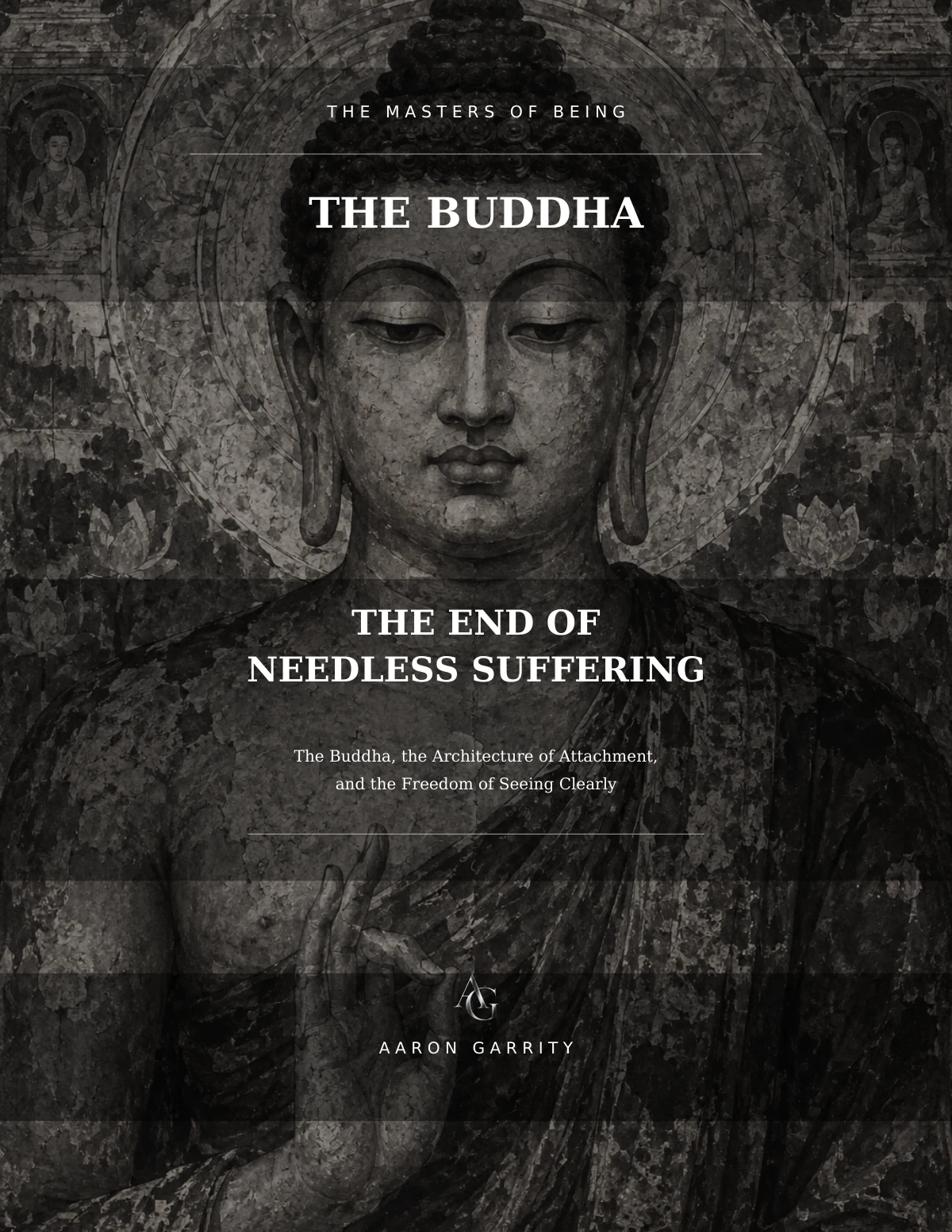
The Buddha is often depicted in a stillness so complete that we may mistake it for withdrawal. His eyes are lowered; his face appears undisturbed. But this is the composure of a person no longer running from what is true. Rising above his head is the ushnisha, a traditional sign of awakened wisdom. Across cultures it has appeared rounded, conical, and sometimes like a flame.
For me, the form carries a further symbolic resonance. It can resemble a pinecone opening upward and call to mind the pineal gland near the center of the brain, long associated in mystical thought with the third eye and the seat of the soul. The image suggests consciousness opening beyond the limits of ordinary perception.
An interesting correspondence appears in Genesis 32. After wrestling through the night and emerging with a new name, Jacob called the place Peniel, meaning "the face of God," because he had seen God face to face and survived. The name invites another association with the pineal gland. I do not believe the correspondence is empty. To me, Peniel becomes both a place and an inward threshold: the point at which divided perception becomes single and the human being begins to see beyond polarity.
Christ appears to speak of the same interior mystery: "If thine eye be single, thy whole body shall be full of light." Perhaps Jacob did not see God merely as one person looks upon another. Perhaps he encountered the divine through the inner eye, where the divided mind becomes one and truth is seen as it is.
Siddhartha used different language, but his awakening points toward the same transformation. The world did not disappear beneath the Bodhi tree. The distortion through which he had been seeing it did.
The doorway is not an escape from the finite. It is the ability to see the finite without demanding that it become permanent.
Clear seeing does not make pain unreal. Some losses divide a life into before and after. It does not cancel grief or deny what happened. It creates enough space between the event and the conclusion for wisdom to enter. The mind may return to its familiar interpretation. It may gather evidence and invite us back into the courtroom where life is always on trial for failing to meet our expectations.
Awakening is not the permanent disappearance of this movement. It is the ability to recognize it before it becomes our master. We notice when fear presents itself as foresight, when desire becomes entitlement, when protection becomes control, and when loyalty becomes the abandonment of self. Nothing has to be condemned. It has to be seen.
A seeker named Bahiya once came to the Buddha with the urgency of a man who believed he had no time left. The Buddha reduced the teaching to the directness of perception: "In the seen will be merely the seen; in the heard, merely the heard." Before identity enters, before memory explains, before desire reaches forward and fear pulls away, there is the immediacy of experience.
Clear seeing interrupts the construction of captivity.
A person may spend years changing the circumstances of his life without seeing the inner structure that travels with him. He leaves one relationship and recreates the same demand in another. He reaches the achievement he believed would settle him and finds the same uneasiness waiting at the summit. We can change the scenery without changing the seeing. Then the palace follows us into the forest.
Siddhartha left a physical palace, but the deeper renunciation had to occur within him. We all carry such architecture. The child who learned that love had to be earned may become an adult who cannot rest without guilt. The person who once knew poverty may accumulate far beyond need and still feel one disaster away from having nothing. The leader who was humiliated may build an empire whose hidden purpose is to ensure that no one can ever make him feel powerless again.
To see clearly is to recognize that the present is sometimes being governed by a person we no longer are, protecting us from a world that no longer exists. Compassion begins here. We did not choose every structure that formed within us. Some were built before we possessed language. Some helped us survive.
But survival strategies do not know when their work is complete. We do not free ourselves by hating them. We thank them for carrying us, then release them from leadership.
Shame says: You should have known better. Awareness says: Now you can see. One closes the door. The other opens it. This is not permission to avoid responsibility. It is how we become capable of bearing enough truth to be responsible.
Clear seeing changes fatherhood. We see the child before the future we imagined for the child. It changes leadership. We become less threatened by information that contradicts us. It changes the way we age. The mirror stops being an accusation. The body is not failing because it cannot remain what it was at thirty; it is completing the honest movement of being alive.
The culture often tells us to resist age, obscurity, and change as though movement were humiliation. The Buddha asks us to understand movement. Resistance may preserve an appearance for a while. Understanding restores relationship with what is changing.
Internal freedom is the pause in which we can see the force moving through us before we call it destiny. Between insult and response, pain has not yet become retaliation. Between desire and action, longing has not yet become captivity. Between loss and identity, grief has not yet become the meaning of an entire life.
The awakened life is lived inside those moments. Not perfectly. Consciously. We will still react, become attached, and mistake fear for wisdom. Awakening should never become another identity through which we place ourselves above ordinary struggle. The moment we need to be awakened, awakening has become another possession.
Then nothing stands between us and the life directly before us: the cup in the hand, the face across the table, the breath entering and leaving, the child who is still young today, the truth we have delayed because speaking it may change the shape of our life.
Seeing clearly does not give us a different life. It gives us this life without the veil of our constant argument with it. This is the end of needless suffering. Not the end of heartbreak, illness, uncertainty, betrayal, aging, or death. It is the end of demanding that these conditions disappear before peace becomes possible.
The Buddha remained in the world after awakening. He walked dusty roads and entered villages. He taught people divided by caste, desire, grief, power, and fear. He met kings without becoming impressed by power and outcasts without becoming contaminated by the judgment of society.
For decades, the former prince owned almost nothing. Yet he carried an authority no palace had been able to give him.
Then the teacher who had first awakened to aging, illness, and death entered each of them himself. On his final journey, his body weakened. Ananda struggled with the approaching separation. The Buddha did not shame his grief. He reminded him that separation from what is dear belongs to conditioned life.
He rested when the body required rest. He accepted water. He continued to speak while strength remained. He prepared a community to continue without his physical presence. He did not build a throne around his departure.
Tradition remembers his final instruction as a return to the truth that had opened the path: "All conditioned things are impermanent. Strive on with diligence." Awakening did not exempt him from being human. It freed him from being internally governed by the conditions of being human.
The doorway does not open somewhere above the world. It opens within the act of seeing the world without distortion. It is entered through attention, through the willingness to see what is true before asking whether we like it, and through the courage to release what reality has already changed.
When that insistence ends, life does not become smaller. It becomes immediate: the sound of a child laughing from another room, the aging hand of a parent, the smaller hand of a grandchild, the silence after an honest apology, the morning light falling across a floor we once hurried past because the future seemed more important than the day.
Nothing has become permanent. Nothing has become controllable. Yet everything has become available.
Life is as it is. The question is no longer how to force it into the shape we prepared. The question is quieter and more demanding: What will we do with what is present with us?
This is awakening. Not departure. Presence. Not escape. Freedom.
EPILOGUE WHEN THE HAND OPENS
When I think of the Buddha now, I do not first see the palace, the forest, or even the tree beneath which he awakened.
I see the hand.
Sometimes it rests open in his lap. Sometimes it reaches toward the earth. Sometimes it rises with the palm facing outward, offering reassurance to the person standing before him. The hand is not empty because it failed to acquire. It is empty because it no longer needs to close. This may be the simplest image of the freedom Siddhartha discovered. He had lived among people whose hands could command almost anything. Servants moved when the palace requested movement. Music answered silence. Gardens were arranged to conceal decay. Every visible detail reinforced the belief that life could be organized around the preferences of the prince.
Yet the hand that summoned pleasure could not stop an old man from aging. It could not restore health to the sick or call the dead back into the body. Power reached its limit at the palace gate. Siddhartha entered the forest and made the opposite mistake. He attempted to conquer through deprivation what abundance had been unable to control. He closed his hand around discipline, purity, and the identity of the exceptional seeker.
That hand also had to open. It opened to receive nourishment. It opened toward the earth when fear demanded proof. It opened when he rose from beneath the tree and walked back toward a world still filled with grief, desire, power, tenderness, and loss. The open hand did not mean that nothing mattered. It meant that nothing had to be possessed in order to matter.
That distinction has become increasingly personal to me. I have known the satisfaction of building and the weight of maintaining what has been built. I have lived with scarcity and opulence, with ambition and consequence, with the strange discovery that the outward life can expand while the inward life becomes heavy. Every possession carries a small request. Every position creates something to defend. Every achievement invites the fear that the person we became through attaining it may disappear if it is lost.
We believe we are holding our lives together. Sometimes our lives are holding us in place. The Buddha did not make poverty sacred or success shameful. He exposed the hidden moment when having becomes needing, when leadership becomes identity, when love becomes ownership, and when responsibility becomes the belief that everything depends upon our refusal to rest. The captivity is not always in the thing.
It is in the closing of the hand. I have closed mine around businesses, relationships, explanations, and former versions of myself. I have wanted people to understand what I carried, why I made certain decisions, and what those decisions cost me. There are arguments the mind continues long after everyone else has left the room. We imagine that if we finally find the perfect language, reality will reopen the case. The person will understand. The betrayal will become less true. The years will return and arrange themselves differently.
But the past does not respond to eloquence. At some point, the hand must open without receiving the answer it believed it was owed. This is not surrender in the sense of defeat. It is the recognition
that continued grasping is no longer protecting anything sacred. It is only preventing the life that remains from being touched. The Buddha’s liberation was not a withdrawal from relationship. After awakening, he rose and walked toward people. The tree was not the conclusion.
It was the place from which he became capable of returning. That may be the measure of any awakening. Does what we have seen make us more available to the human beings before us? Does it make us more honest about the consequences of our choices? Does it soften the need to defend ourselves long enough for another person’s experience to become real? If realization makes us less reachable, it may only be another palace.
A spiritual palace is still a palace. It can be built from insight, purity, and the private conviction that we see what others cannot. Its walls may be invisible, but the people who love us still feel their presence. Fatherhood has taught me why the open hand matters. A child first knows the parent as a hand. The hand lifts, steadies, feeds, guides, and protects. It reaches across the street before the child understands the danger. It holds the bicycle until balance begins to appear.
Then, almost imperceptibly, the purpose of the hand changes. What once protected must learn not to prevent. What once guided must allow discovery. What once held must make room for the child to become someone whose life will not remain inside the parent’s design. There is grief in that opening. The hand remembers when it was necessary. The heart remembers being the center of a smaller world.
But love cannot complete its work while insisting upon permanent necessity. A father does not lose the child when the child becomes free. He loses only the version of fatherhood that depended upon being needed in the same way forever.
The open hand does not abandon.
It accompanies without imprisoning. Leadership asks for the same release. A leader’s hand must sometimes close around responsibility. Decisions must be made. Standards must be protected. Harm must be confronted. Nonattachment is not the refusal to exercise authority. But authority becomes dangerous when the hand forgets how to open. Stewardship becomes control. Honest disagreement feels like betrayal. Succession feels like disappearance. The awakened leader builds what can continue without him.
He gives fully without demanding immortality in return. Every master eventually asks this of us. Not that we admire the life they lived, but that we become responsible for the life their seeing makes possible within us. The Buddha cannot release my attachments for me. He can reveal how pleasure becomes craving, how pain becomes identity, how fear becomes control, and how love becomes possession. He can touch the earth. He can point toward the open hand.
But I must notice what I am still gripping. Perhaps it is a person whose freedom we experience as rejection. Perhaps it is an ambition that once gave direction but now consumes the life it was meant to serve. Perhaps it is an injury that has become so central to identity that healing feels like the loss of the self who survived it. Perhaps it is simply the belief that we should have become someone else by now.
The hand closes for understandable reasons. It closes because something mattered. It closes because we were frightened. It closes because there were seasons when holding on was how we survived. I know this because my own hand still closes. The difference is not that it never closes,
but that I recognize the movement sooner and remember that opening remains possible. We do not need to hate the hand for closing. We only need to recognize when it is safe to open.
Awakening is not the violence of forcing the hand open. It is the patience of seeing why it closed. Then, without condemnation, we release one finger at a time. The demand for an apology. The need to be understood. The future we assigned to another person. The identity built around success. The belief that grief must remain unchanged to prove that love was real. What remains is not emptiness in the ordinary sense.
What remains is space. Space to love the person who is actually here. Space to lead according to what is true now. Space to let the child grow. Space to remember without continuing to bleed at the command of memory. Space to build again without asking the next creation to rescue us from the last one.
This is the freedom of the open hand.
It can receive because it is not already occupied by what has ended. It can give because it is not converting every gift into debt. It can touch the world without requiring the world to remain within its grasp. When I return to the image of the Buddha, I understand why the stillness of his face has survived so many centuries. It is not the expression of a man untouched by life.
It is the expression of a man no longer arguing with life for being alive. He had been a son, husband, father, seeker, teacher, leader, aging man, and dying body. Awakening did not erase those identities. It prevented them from becoming prisons. That is why his life still reaches us. Not because he escaped the human condition, but because he entered it completely and discovered that freedom could exist within it.
The Buddha did not speak of God in the language I use. Still, the image that returns to me is a river. The river is God; the drop within it is each of us. The drop cannot command the current, yet it is not separate from the water carrying it. The rapids, the grandeur, the terror, the sudden bend, and the long calm all belong to the life of the river. Freedom is not making the river obey. It is meeting the current consciously and discovering that even within its movement, we remain capable of wonder, courage, creation, and love.
The palace will always tempt us. The forest will always tempt us. One promises that enough pleasure will protect us from pain. The other promises that enough severity will purify us of need.
The Buddha sits between them. Not halfway. Free. His hand is open. The earth remains beneath it. Life continues to change. And nothing essential is being lost. Because what is real was never ours to possess. Only to meet. Only to love. Only to release.
SOURCE NOTE
A NOTE ON SOURCES AND LANGUAGE
This writing is a literary and contemplative encounter with Siddhartha Gautama and the teachings attributed to the Buddha. It is not a new scripture, a formal biography, or a substitute for the Buddhist canons.
EARLY DISCOURSES CONSULTED
The Turning of the Dhamma Wheel, Samyutta Nikaya 56.11; The Arrow, Samyutta Nikaya 36.6; Intention and Action, Anguttara Nikaya 6.63; Advice to Rahula at Ambalatthika, Majjhima Nikaya 61; With Angulimala, Majjhima Nikaya 86; To Bahiya, Udana 1.10; Advice to Sigala, Digha Nikaya 31; and The Great Passing, Digha Nikaya 16.
Brief teachings from these discourses have been rendered or lightly adapted for cadence within the surrounding prose. The mustard seed story of Kisa Gotami belongs to the later commentarial tradition associated with the Dhammapada and is identified in the writing as tradition rather than direct early discourse.
ON THE LIFE OF SIDDHARTHA
The biographical tradition surrounding Siddhartha developed across centuries and cultures. The palace, the Four Sights, Sujata's offering, Mara, the earth touching gesture, Kisa Gotami, Angulimala, Rahula, Ananda, and the final journey are presented as carriers of spiritual and psychological truth. Where traditions differ, the writing favors the meaning of the encounter without claiming certainty the historical record cannot provide.
ON COMPARATIVE SYMBOLISM
The ushnisha is traditionally a sign of awakened wisdom. The pinecone and pineal association is Aaron Garrity's contemplative interpretation. Genesis 32 names Peniel as the place where Jacob saw God face to face, and the Hebrew name means "face of God." The writing treats the correspondence between Peniel and the pineal as an inward spiritual connection rather than a claim about the historical development of language. Its language of divided and unified perception is contemplative rather than clinical.
ON MODERN REFERENCES
James Allen's As a Man Thinketh informs the garden image. The line from A Few Good Men is used as a cultural image of the mind's resistance to truths that threaten identity. No equivalence with Buddhist scripture is intended.
Modern narrative retellings have helped restore immediacy to the Buddha's life. Their value here lies in the permission to encounter Siddhartha as a human being moving through protection, contradiction, extremity, awakening, relationship, leadership, aging, and death. The language and interpretation remain original to Aaron Garrity.